

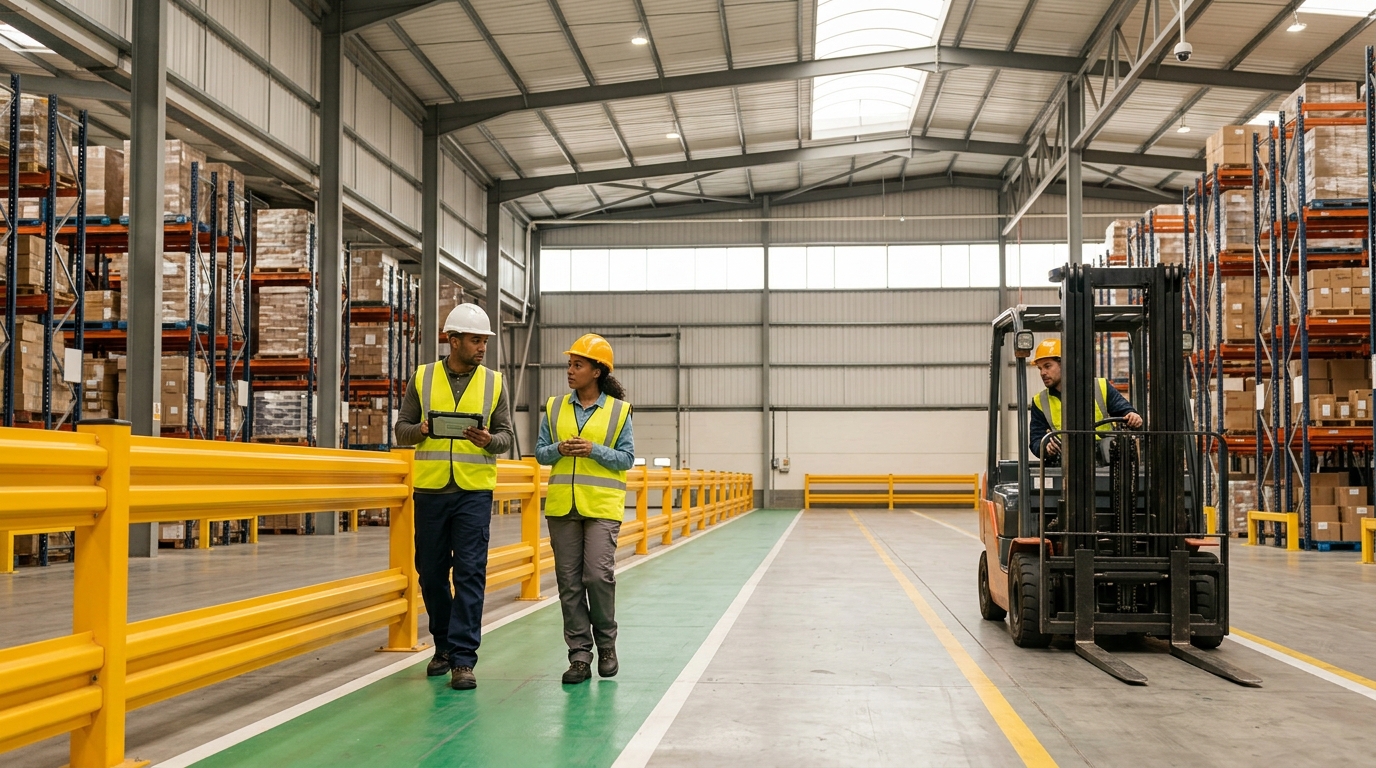
Forklift pedestrian safety comes down to one fact: trucks and people on foot share the same aisles, doors and docks all day. Most near misses end with a horn and a raised hand, and the serious incidents tend to happen at the same few places on every site. This guide shows where those places are, which controls work in which order, and how to use the CCTV already on site to find your own hotspots before an incident does.
Why forklift pedestrian safety needs its own plan
UK, US and EU figures point the same way. In Great Britain, lift trucks are involved in about a quarter of all workplace transport accidents, according to the Health and Safety Executive (HSE). In the United States, forklifts were the source of 84 work-related deaths in 2024, based on Bureau of Labor Statistics data compiled by the National Safety Council. In the EU, transportation and storage accounted for 15.9% of fatal accidents at work in 2024, the second-highest share after construction, a figure from Eurostat that also covers road haulage.
People on foot carry a large share of that risk. A NIOSH analysis of 1,021 US forklift deaths between 1980 and 1994 found that one in five involved a worker on foot struck by a forklift. A study of 171 collisions involving powered industrial vehicles at eight US car plants found that in half of the cases, an employee on foot was struck by the vehicle or the load it carried.
This guide treats those collisions as a layout problem first: trucks and people meeting where neither can see the other in time. For the wider picture of accident prevention, see our guide on how to reduce accidents at work with video analysis.
Where collisions happen: six hotspots to check first
1. Blind rack ends and cross aisles
A picker steps out from between two racks just as a truck turns the corner with a load blocking the driver’s view. US rules require drivers to slow down and sound the horn at cross aisles and other locations where vision is obstructed (OSHA 1910.178). In the car-plant study, overhead mirrors at intersections and blind corners were associated with about one-third the odds of a collision, while obstructions narrowing the aisle were associated with nearly double the odds (data from 1992–95).
2. Doors, gates and dock doors
A door hides whatever is on the other side. Someone pushes through a pedestrian door straight into a truck route, or walks through the vehicle door because it is closer to where they are going. The HSE advises sites to provide separate vehicle and pedestrian doors wherever possible.
3. Reversing
Forklifts reverse constantly: out of a rack, away from a trailer, around a tight corner. Nearly a quarter of all deaths involving workplace transport in Great Britain occur during reversing, according to the HSE. The driver is checking one direction while a person approaches from another.
4. Shift change and breaks
Ten minutes before a shift ends, the floor fills with people heading for the time clock, the break room and the exits, sometimes along the same routes trucks use to clear the last loads. NIOSH recommends restricting forklift use near time clocks, break rooms, cafeterias and main exits when foot traffic peaks, such as at the end of a shift or during breaks.
5. Loading bays with visiting drivers
Visiting drivers are new to your routes, and they may wait on foot while their trailer is loaded. In 2020, a visiting HGV driver waiting for his trailer to be loaded at Kingsland Drinks in Irlam, England, was struck and killed by a forklift. There was no pedestrian and vehicle segregation in the loading area, and the company was fined £800,000 in 2023 (Food Manufacture).
6. Workstations next to travel aisles
Packing benches, label printers and quality checks placed along a travel aisle keep people at the edge of a truck route for hours. OSHA forbids driving a truck up to anyone standing in front of a bench or other fixed object: a person in that position has nowhere to step away.
What the rules expect
Regulators agree on the principle: keep people and trucks apart, and make routes obvious.
- EU: the Work Equipment Directive 2009/104/EC requires organisational measures to prevent workers on foot coming within the area of operation of self-propelled work equipment, and traffic rules wherever work equipment moves around a work area. The Workplace Directive 89/654/EEC requires a sufficient safety clearance for pedestrians where means of transport use traffic routes.
- UK: HSE’s lift-truck guidance (L117) says to prohibit pedestrians from areas where lift trucks are operating where possible. Otherwise, separate them, with physical barriers where possible and clearly marked pedestrian routes and crossing places. It also lists further measures such as visibility aids, for example convex mirrors or CCTV, and presence-sensing equipment that sounds a warning when a person is detected.
- US: OSHA’s guidance on pedestrian traffic says forklift traffic should be separated from other workers and pedestrians where possible, on top of the horn and speed rules in 1910.178.
Controls in the right order
After an incident, the first instinct is often to buy technology. The order that works runs the other way: remove the meeting point if you can, separate it if you can’t, and add detection on top.
| Step | Examples | What it fixes | Watch out for |
|---|---|---|---|
| 1. Remove | Truck-only aisles; time clocks, break areas and workstations moved away from truck routes | The meeting point disappears | Not always possible in older buildings |
| 2. Separate | Physical barriers, separate pedestrian doors, marked walkways and crossings | People and trucks use different space | Shortcuts appear wherever the walkway is longer |
| 3. Organize | Time rules at shift change, one-way routes, speed limits by area | Fewer meetings at peak times | Rules fade without checks |
| 4. Make visible | Mirrors at blind corners, warning lights, horns at cross aisles | Drivers and pedestrians see each other sooner | Noise and habit dull every warning |
| 5. Detect and alert | On-truck sensors, tags, analytics on fixed CCTV | Warnings, plus a record of near misses | Supports steps 1–4; never replaces them |
| 6. Train | Drivers, pedestrians and visitors | Everyone knows the routes and rules | Weakest when used on its own |
Fixed cameras or on-truck sensors?
Detection technology comes in two families, and they answer different questions. On-truck systems protect the space around one vehicle. Analytics on fixed cameras watch a whole zone and show where and when the same situations repeat. (For how the detection itself works, see AI in video analytics explained.)
| On-truck sensors and tags | Analytics on fixed CCTV | |
|---|---|---|
| Watches | The space around one truck | A whole zone: a crossing, a dock, an aisle |
| Who it detects | Tag systems detect only people wearing a tag | Anyone the camera can actually see, not people hidden by racking or loads |
| Typical response | A warning to the driver; some systems automatically slow the truck down | An alert to supervisors and a log of events |
| Weak spots | Cost per truck; tags left in a locker | Racking that blocks the view; lighting and camera angles |
| Best for | Last-second warnings | Finding hotspots and checking that rules hold |
Neither family is a substitute for barriers. Analytics on fixed cameras alerts people; it does not stop a truck. Camera-based detection also has blind spots: research on pedestrian detection in warehouses notes that a worker who is severely occluded by objects may not be detected. When you add or move cameras, place them from your hotspot map, not the other way round.
Find your hotspots in 30 days with the cameras you already have
Many sites already have cameras pointed at docks, doors and main aisles. Before you change the layout or buy hardware, use them to measure where people and trucks actually meet.
- Map the meeting points. On a floor plan, mark every crossing, door, dock door, rack end, time clock and break-area entrance. Note which ones a camera already covers. For points no camera sees, log events during floor walks or from near-miss reports, so the baseline doesn’t just show where cameras happen to point.
- Define the events. Decide what counts at each point: a person entering a truck-only aisle, someone crossing a truck route outside the marked crossing, a pedestrian door used as a shortcut into a truck route.
- Collect for 30 days. Count events by location, shift and hour, either automatically with analytics or by hand: review the same three time windows per camera each day (shift change, the main delivery peak and one quiet hour) and tally what you see. A month covers different shift patterns, delivery peaks and staffing levels.
- Review weekly. Go through the top three locations with supervisors, a few drivers and the people who walk that route. Ask why people take it: a missing crossing, a door in the wrong place, a break schedule that sends everyone across the dock at once.
- Fix the layout. Move the crossing, add a barrier, add a separate pedestrian door or change the break times.
- Measure again. Run the next 30 days the same way. The numbers that matter are events per location per shift, whether they fall where you made changes and, if you count all crossings, the share made outside the marked route.
Instead of debating whether a crossing is dangerous, you can see how often people use it, when, and whether your fix worked.
Monitor zones, not people
Camera analytics only works if your team trusts it. Before you start, involve your data protection officer and, where you have them, your works council or employee representatives. Tell staff what is analyzed and why: the goal is to find unsafe places and fix them, not to discipline individuals. Keep the focus on locations and events, and keep recordings no longer than you need them.
How Vidiana helps
Vidiana uses AI video analytics with existing CCTV systems to turn camera footage into safety alerts and operational data. In the method above, restricted-area monitoring flags people entering truck-only aisles (step 2). Counting of people, objects and events with custom reporting gives you events per location and shift (steps 3 and 6). Real-time alerts by email, SMS or phone call reach a supervisor while the situation is still on the floor. Deployment can be in the cloud or on-premises. If PPE is also a concern on your site, read about PPE monitoring with video analytics.
Start this week
Walk the floor at shift change with a floor plan and a pen. Mark the three places where people and trucks meet most often, and check which of them a camera already covers. That short list is the start of your forklift pedestrian safety plan, and a practical agenda for a conversation about analytics on the cameras you already have.
